The Locked Chocolate Aisle: How Incentives, Risk, and AI Are Reshaping Retail Behaviour
Chocolate bars in lockboxes sound like a quirky news story. In reality, they reveal how incentives, risk management, and AI‑driven surveillance collide on the supermarket shelf – and why marketers, not just loss‑prevention teams, should care.

The sight of family-sized chocolate bars locked in clear plastic boxes, requiring a staff member with a key for purchase, is absurd. In several UK supermarkets, chocolate is now considered ‘high-risk’ stock, alongside alcohol, razor blades, and meat. One retailer even calls it ‘the new buzzword for organised crime’. Behind this oddity lies a harsh commercial reality: branded confectionery can be worth hundreds of pounds, and a single offender can steal £200-£300 worth of stock in a rucksack, costing stores thousands in a week.
Retailers are responding with reduced shelf exposure, more cameras, and technology-enabled detection, but research suggests these measures are effective in some contexts and weak in others, depending on product type and implementation (Hayes et al., 2019; Sidebottom et al., 2017).
This quirky news story reveals how modern retail works, where incentives, opportunity, and risk management collide on the supermarket shelf. It’s not just about stopping shoplifters; it’s about how everyday marketing decisions make some products crime targets, and how the tools used to protect them, from lockboxes to AI-driven surveillance, are reshaping the customer experience.[bbc.co.uk]
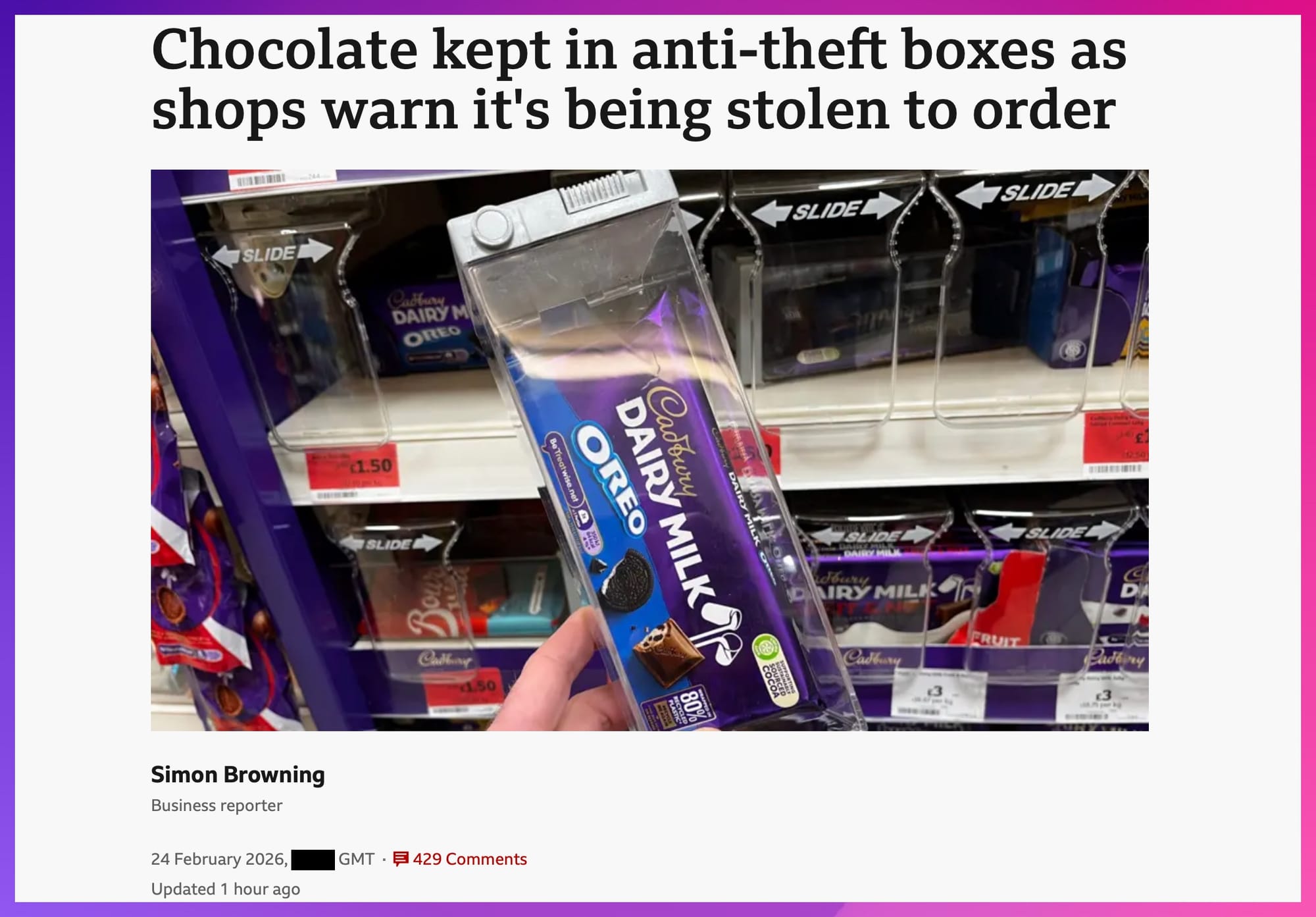
On one level, chocolate is an odd candidate for “high‑risk” status: relatively cheap, ubiquitous, and marketed as an everyday comfort rather than a luxury. But viewed through an opportunity lens, it is almost a perfect target. Routine activity theory holds that everyday crime flourishes when three conditions align: a likely offender, a suitable target, and the absence of a capable guardian (Felson, 1996). In busy supermarkets with stretched staff, self‑checkout areas and long aisles, those conditions are easy to find.
Criminologists often describe especially vulnerable products as “CRAVED”: Concealable, Removable, Available, Valuable, Enjoyable and Disposable, a framework developed by Ronald Clarke to explain why certain “hot products” attract theft (Clarke, 1999). Chocolate ticks most of those boxes. Individual bars and bags are small and easy to hide. Stock is heavily available, often with multiple facings or end‑of‑aisle displays designed to maximise impulse buying. Branded chocolate is both enjoyable and predictably valuable: demand is strong and stable, and thieves know it will sell on quickly, just as they do with other CRAVED grocery items such as meat, cheese and alcohol.
The final piece is disposability. UK retailers and trade bodies report that stolen food and household goods are increasingly resold into local shops, market stalls, restaurants and via online platforms, often by “professional” shoplifters stealing to order or to fund addiction (The Guardian, 2024; British Independent Retailers Association [BIRA], 2024). That makes chocolate less like a one‑off impulse theft and more like an everyday commodity in an illicit supply chain. From a marketing perspective, this is the uncomfortable twist: the very things brands and retailers work hard to create – strong recognition, prominent placement, abundant stock and reliable turnover – also increase a product’s appeal as “criminal inventory”. Coffee, razors, baby formula and meat follow similar patterns in police and retail reports; chocolate is simply the most visible current example.

The Shadow Value Chain: Theft to Order as Strategy
Talk of “chocolate theft” can sound like a modern moral panic, but the BBC reporting makes a more specific claim: some of this activity is organised and “to order,” with stolen stock then moved on quickly. That matters because it shifts the story from opportunistic shoplifting to something closer to a supply chain problem—one in which demand, resale routes, and the ease of converting goods into cash shape what is stolen and how often.
This is where the “D” in CRAVED—disposable—does the heaviest lifting. Clarke argues that while multiple attributes explain why certain products are attractive, the volume of theft is often driven by how easily goods can be sold on, especially for high‑volume or habitual thieves who need reliable outlets. In other words, theft becomes scalable when disposal is scalable: regular buyers, regular channels, predictable prices. Retailers and trade bodies have described precisely these kinds of channels—goods flowing into local shops, market stalls, hospitality venues, and online resale—creating an illicit distribution system that can sit alongside legitimate retail.
Once you view theft as a market, offender behaviour looks less random. In situational crime prevention and rational choice terms, the would‑be thief weighs effort, risk and reward at specific decision points, and those calculations can be altered by changing the immediate environment (Hayes et al., 2019). “Theft to order” is essentially a rationalisation device: it reduces uncertainty (you already have a buyer), increases expected reward (you know the price), and can shorten the time goods need to be stored or concealed. That is also why “hot products” can change quickly—when demand spikes, when resale outlets expand, or when other categories become harder to steal, offenders adapt and switch. (Hayes et al., 2019).
For marketers and category leaders, the uncomfortable implication is that brand strength and distribution breadth do not only create legitimate demand; they can also create illegitimate demand conditions. A product that is widely recognised, heavily stocked, and easy to authenticate at a glance is not just easy to buy—it is easy to resell. The question is no longer simply “how do we reduce shrink?”, but “what parts of our own commercial system—availability, fixture design, promotional volume, and predictable pricing—make resale frictionless for someone operating outside it?”

Target Hardening that Works (Sometimes): Tags, Wraps, and the “Effort–Risk–Reward” Mechanisms
If “theft to order” is the demand side of the problem, then retailer countermeasures are an attempt to disrupt the decision calculus at the shelf edge and at the exit. Across the evidence base on retail tagging, three plausible causal mechanisms appear repeatedly: increasing the risks of detection, increasing the effort required to remove or exit with goods, and reducing rewards (benefit denial). (Sidebottom et al., 2017). Importantly, Sidebottom and colleagues stress that these mechanisms do not “fire” automatically: whether tags reduce theft depends on moderating conditions such as staff responses, store layout, the type of tag, product type, and (sometimes) police/courts follow‑through.
Two practical implications flow from this. First, visible security measures often aim to deter by changing perceived risk, whereas concealed measures depend more on actual detection and response (e.g., alarms that staff act upon). (Sidebottom et al., 2017). Second, technology effects are not uniform across merchandise: the same device can work well for some items and poorly for others, because form factor, packaging, and “how stealable” the item is shape how easily offenders can defeat or ignore protection. (Hayes et al., 2019).
Evidence here is mixed but instructive. The systematic review of tagging found that only a small number of studies provide quantitative estimates, and heterogeneity in tags and outcome measures makes firm conclusions difficult; nonetheless, it reports suggestive evidence that more visible tags tend to be associated with greater reductions in theft/shrinkage than less visible tags. (Sidebottom et al., 2017). That finding aligns with the idea that deterrence requires offenders to notice and interpret the cue as credible—an emphasis that also appears in experimental work on conspicuous “spider wrap” devices that are designed to be seen, recognised, and feared because of alarms and exit detection. (Hayes et al., 2019).
From a brand/retail strategy standpoint, the key point is that “target hardening” is not a single switch you turn on. It is a mechanism‑and‑context problem: choose interventions that (a) are visible enough to deter where deterrence is plausible, (b) are operationally supported by staff and layout so alarms lead to action, and (c) fit the product’s physical and commercial reality (size, packaging, on‑shelf quantity, demand intensity). (Sidebottom et al., 2017; Hayes et al., 2019)

Go Upstream: Disrupting Disposal and “Denying Benefits”
Because “to order” theft depends on reliable resale, the most leverage often sits after the taking: making stolen goods harder to move, easier to identify, or less useful once stolen. Clarke’s “hot products” analysis argues that while CRAVED explains what gets stolen, the volume of theft often depends most on “disposable”—how easily offenders can sell goods—so interventions that disrupt disposal channels can depress theft at scale. (Clarke, 1999). Put simply: if you make resale fragile, you make the entire business model fragile.
Clarke also challenges the common objection that “thieves will just steal something else.” He notes that offenders choose products for specific reasons; if prevention removes those opportunities, substitution is not automatic, and displacement is rarely 100% in the empirical literature—sometimes benefits even “diffuse” beyond the protected items. That is strategically important for retailers because it legitimises focusing on a short list of high-demand, high-disposal products rather than spreading resources thinly across all shrink.

Tactics that attack disposal
Two core families of “reduce rewards” strategies that are increasingly enabled by technology: property identification (linking an item to lawful ownership) and benefit denial (making the product unusable or less valuable when stolen). This could include security coding for electronics, micro-dot marking, and “smart water” with indelible dye (visible under UV), as well as the broader idea of designing products so stolen units can be identified and/or disabled.
Operationally, the logic is to raise the risk and reduce the payoff in the resale step, not only at the shelf edge. High-volume thieves depend on being able to shift goods repeatedly; if handlers and buyers face higher identification risk (or reduced value because items can be traced/disabled), throughput drops and so does incentive to steal that product category. This is the policy bridge between “hot products” and “markets for stolen goods”: they are “two sides of the same coin,” and you cannot sustainably reduce theft of highly disposable goods without changing the downstream market conditions.

Why this matters for retailers (and brands)
From a commercial perspective, upstream disruption is also a way to avoid endlessly escalating in-store hardening (locks, guards, cases) that can damage sales and customer experience. Clarke explicitly notes that prevention has traditionally focused on target hardening (making theft harder/riskier at the point of taking), but argues there is substantial untapped scope in reward reduction—especially as technology makes identification and benefit denial more practical. For “to order” products, it can be more efficient to treat the problem as illicit distribution management (closing off outlets, increasing traceability, reducing usability), not just as “shrink on aisle 3.”
Implementation playbook: reducing theft without killing sales
A practical response to “theft to order” needs to combine shelf-edge friction (slow removal), staff-enabled guardianship (fast intervention), and demand-channel disruption (harder resale). The BBC case examples show retailers already mixing these levers: lockboxes and shelf-edge barriers for chocolate, increased CCTV and AI-based detection, reduced on-shelf quantities, and de-promoting chocolate from easy-access end-of-aisle displays. This is consistent with the broader point that theft concentrates on “hot products,” and that how much is stolen often hinges on ease of disposal as much as ease of taking.
What retailers can do now (low-regret actions)
- Re-engineer availability: Keep vulnerable lines off end caps and other “grab-and-go” placements, reduce facings and replenish more frequently (“half-fill shelves”) to cap loss per incident.
- Increase effort at the point of removal: Use lockboxes/screens selectively on the most targeted SKUs, rather than blanket measures that degrade the whole category experience.
- Increase responsive risk, not just surveillance: CCTV/AI can help identify repeat offenders, but it needs a clear response routine at the till and on the floor (who approaches, when, and how) or it becomes passive recording.
- Protect staff as part of prevention: retail crime includes abuse and intimidation, so procedures should prioritise safe reporting/escalation and reduce lone confrontations.
When to escalate (and where)
The BBC reporting links chocolate theft with wider illicit resale routes (moving stock into other shops and hospitality venues), which implies that store-level hardening alone won’t be enough where networks are operating. In those cases, the emphasis shifts upstream: gathering intelligence, sharing repeat-offender images and incident patterns, and targeting the disposal networks that make high-volume theft economically viable. This aligns with Clarke’s argument that interventions aimed at the “disposable” attribute—disrupting markets and denying benefits—can reduce theft without simply causing one-for-one displacement.

Limits, risks, and how to evaluate “what works”
A key constraint in retail-theft evidence is measurement: many studies rely on “shrinkage” (inventory loss) rather than theft-specific outcomes, and shrink can include error, damage, fraud, and process failures as well as shoplifting. This makes it hard to attribute improvements cleanly to one intervention and helps explain why systematic reviews often find heterogeneous results and limited high-quality economic evaluation. (Sidebottom et al., 2017)
There are also practical and ethical trade-offs in the measures highlighted in the BBC report. Approaches such as extensive CCTV, AI-assisted identification, and maintaining images of suspected shoplifters at tills may raise privacy, fairness, and compliance questions, and they can create reputational risk if applied opaquely or inaccurately. Meanwhile, heavy “target hardening” (lockboxes, screens, moving stock behind counters) can reduce theft but also introduces friction that may depress sales and worsen customer experience—so “success” should be assessed with both loss and sales/service metrics.
A workable evaluation approach, consistent with the lessons from tagging research, is to test interventions as packages and track multiple outcomes over enough time to detect adaptation. Sidebottom et al. emphasise that tag effectiveness is moderated by store/staff factors and implementation strategy, so process measures (alarm response rates, staff compliance, correct application) are as important as outcome measures.
In practice, retailers can run simple A/B or stepped-wedge trials by store or by product line, monitoring (1) unit loss/shrink, (2) sales and availability, (3) staff time and incident reports, and (4) displacement (switching to adjacent SKUs) versus diffusion (wider reductions).
And all because the lady loves...
References
BBC News. (2026). Chocolate kept in anti-theft boxes as shops warn it’s being stolen to order. BBC. https://www.bbc.co.uk/news/articles/ce3gqr7p0lqo
BIRA. (2024, September 1). Bira appears on the BBC to report on retailers buying stolen goods from professional shoplifters. British Independent Retailers Association. https://bira.co.uk/news/bira-appears-on-the-bbc-to-report-on-retailers-buying-stolen-goods-from-professional-shoplifters/[bira.co]
Clarke, R. V. (1999). Hot products: Understanding, anticipating and reducing demand for stolen goods (Police Research Series Paper 112). London: Home Office, Policing and Reducing Crime Unit.
Felson, M. (1996). Preventing retail theft: an application of environmental criminology. Security Journal, 7 (1), 71-75.
Hayes, R., Strome, S., Johns, T., Scicchitano, M., & Downs, D. (2019). Testing the effectiveness of anti-theft wraps across product types in retail environments: A randomized controlled trial. Journal of Experimental Criminology. https://doi.org/10.1007/s11292-019-09365-2
Sidebottom, A., Thornton, A., Tompson, L., Belur, J., Tilley, N., & Bowers, K. (2017). A systematic review of tagging as a method to reduce theft in retail environments. Crime Science, 6(7). https://doi.org/10.1186/s40163-017-0068-y
The Guardian. (2024, August 29). UK shops buying stolen goods from professional shoplifters, retailers say. The Guardian. https://www.theguardian.com/business/article/2024/aug/29/uk-shops-buying-stolen-goods-professional-shoplifters-retailers[theguardian]


